
The Room Where It Happens Is on the Ballot
Most people can name who's on the ballot for president. Almost nobody can tell you the balance of power in their own state legislature, even though that's usually the body deciding what actually gets signed into law where they live. This template exists to close that gap.
What's in the template
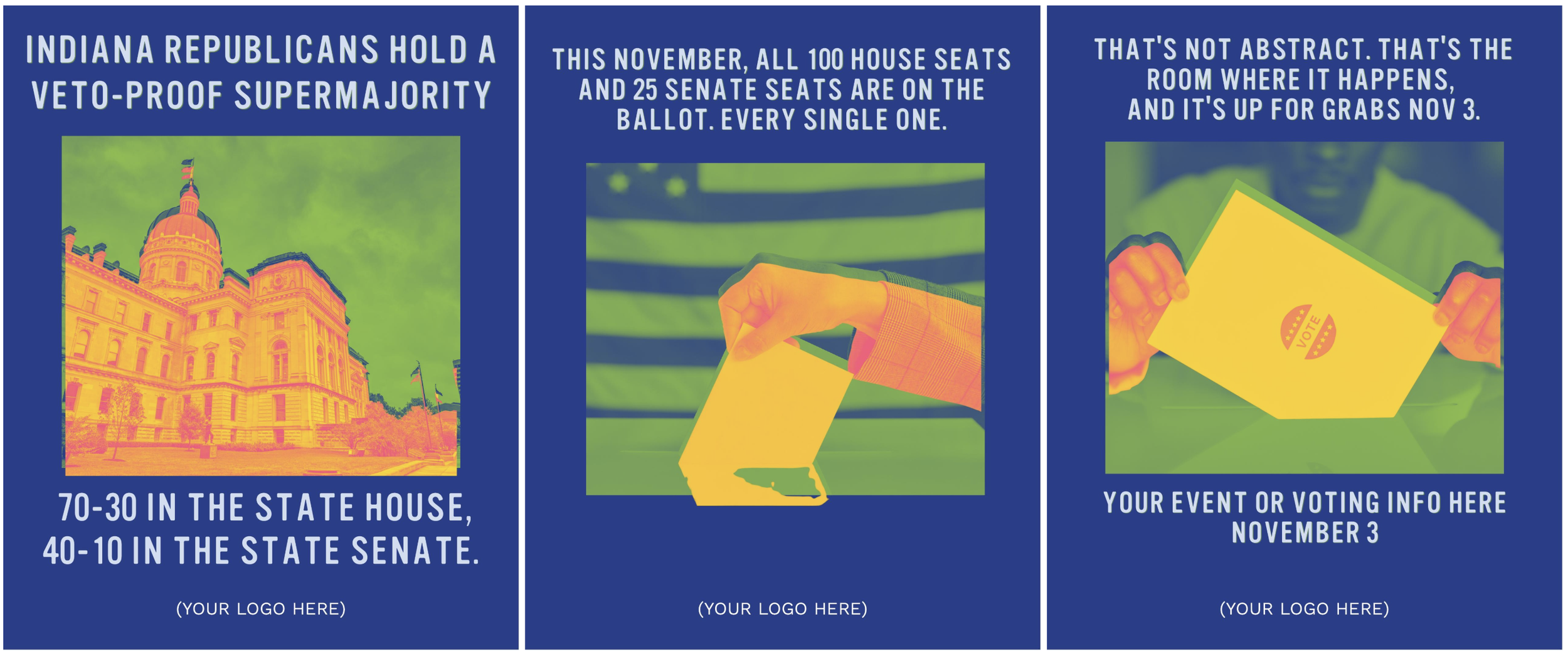
Slide one states the stakes plainly: the party in power holds a veto-proof supermajority, no votes from the other side needed to pass anything. The specific numbers (a 70-30 split in the State House, 40-10 in the State Senate) make the imbalance concrete instead of abstract.
Slide two turns that imbalance into an opportunity: every single seat, all 100 House seats and 25 Senate seats, is on the ballot this November. A supermajority isn't permanent, it's just what happens when not enough people vote in the races that actually set it.
Slide three closes the loop: "The room where it happens is up for grabs Nov 3, but only if you show up. Register. Make a plan. Bring your people." Then space for your specific event or voting info and the date.
Built for Indiana, built to travel
This version is written for Indiana's legislature specifically. If you're organizing somewhere else, the structure carries over directly, you just need your own state's numbers:
Your state's current legislative composition. Your Secretary of State's website, your state legislature's official site, or Ballotpedia will have the current party breakdown in your state House and Senate.
How many seats are actually up this cycle. Not every state legislature is fully up for election every two years, some Senates stagger terms. Confirm the real number for your state and year before you publish, that number is the whole point of slide two.
Your election date, since general election day is the same nationally but any local or off-cycle elections you're highlighting may not be.
Your sources. Cite wherever you pulled the numbers, Ballotpedia and your state legislature's own site are both credible, easily checkable sources.
The stat-then-stakes structure (here's the imbalance, here's why it isn't permanent, here's what to do about it) is the reusable part. The numbers are the only thing that needs to change state to state.
Suggested caption
Use this as a starting point, then swap in your own state's numbers and sources.
[Your state]'s legislature currently has a veto-proof supermajority, [X-X] in the State House, [X-X] in the State Senate, enough to override a veto without a single vote from the other party. This November, [X] House seats and [X] Senate seats are on the ballot.
Local turnout is where that changes first.
[Your event name], [date], [time], [location].
#BringYourPeopleToThePolls #[YourLocalGroup] #Vote[YourState] #ElectionDay2026
Sources: [your state legislature's official site], [Ballotpedia link for your state's legislative session]
How Goshen used it
Indiana Republicans currently hold a 70-30 supermajority in the State House and 40-10 in the Senate, enough to override a veto without a single Democratic vote. This November, all 100 House seats and 25 Senate seats are on the ballot.
Local turnout is where that changes first.
Bring Your People to the Polls Kickoff Party, October 5, 6:30 PM, Goshen Theater.
#BringYourPeopleToThePolls #GoshenCityDemocraticParty #VoteIndiana #ElectionDay2026
Sources: Indiana General Assembly, Wikipedia, Ballotpedia, 2026 Indiana legislative session
